Please note that the Anime DB and Manga DB sections of the site are again working. An enforced update of the underlying PHP to a newer and stricter version caused problems with some old code, but these are now fixed. The outage lasted from 26 Apr 2023 to 29 May 2023.
Children Who Chase Lost Voices
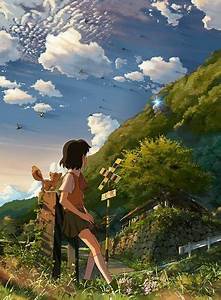 Children Who Chase Lost Voices (2011 movie) by Makoto Shinkai, also known as Journey to Agartha.
Agartha is a world under the earth, a place of great beauty and also unimaginable dangers. It has a reputation as a place in which the dead can be brought to life. The young heroine, Asuna, sees a monster that has come up from below and is rescued by a boy, Shun, who has also come from Agartha. Asuna’s new schoolteacher, Mr Morisaki, turns out to know a lot about Agartha legends, and his beloved wife died some years ago. Asuna has also lost her father.
Asuna is dragged into Morisaki’s quest and enters Agartha, where she has a series of frightening adventures.
This movie is pretty good and has a somewhat darker tone than a typical Studio Ghibli movie. The animation is perhaps not as slick as a Studio Ghibli product and the resolution a shade muted.
009 Re: Cyborg
 009 Re:Cyborg is a 2012 Japanese anime film by Kenji Kamiyama. The film takes place in Cyborg 009’s future timeline.
The year is 2013. Skyscraper bombings are happening all over the world, by the direction of a force called “His Voice”. 27 years after the 00 Cyborg team disbanded. Joe (009) is hidden as a high school student whose memory is reset every three years by his creator, Professor Gilmore.
To fight the menace, the team has to be resurrected and Joe’s memories restored. The cyborgs all have super-powers which become more amazing as the movie progresses.
This is a dramatic film with continuous action and some strikingly framed shots. The plot, involving a religion, philosophising about the need for destruction and so forth is a bit hokey but the action and visuals make up for it. Worth a look.
Anime and Manga database fixed
You can now use the Anime or Manga databases in the menu line as they have been re-coded following an enforced PHP version upgrade.
In the static part of the site, various obsolete pages and links have been removed.
A letter to Momo – anime movie
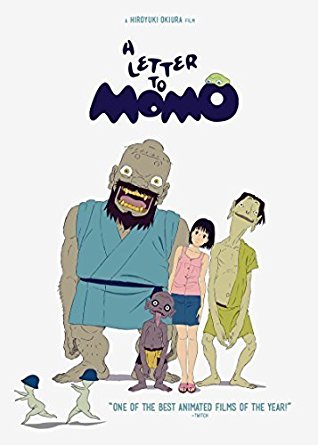 ‘A Letter to Momo’ is an animated movie from Production IG, directed by Hiroyuki Okiura. (120 mins).
Young Momo’s mother returns to her native island in the Japanese Inland Sea after the sudden death of Momo’s father. Momo is upset because she argued with her father just before his disappearance. She carries the beginning of a letter to her that her father started but left unfinished.
The story starts as family-centred but supernatural elements gradually intrude. Three greedy goblins have been assigned by Above to watch Momo and her mother. A fairly gentle comedy-drama develops.
I liked this movie a lot. The human character designs are attractive, Momo is an appealing character, and the backgrounds are very detailed.
This movie was released in 2011 but seems to have attracted little attention. The edition I bought is the UK Collector’s Edition, with BD+DVD in an attractive slip-cased box, with a booklet about the making of the movie.
Highly recommended.
The Red Turtle (animated movie)
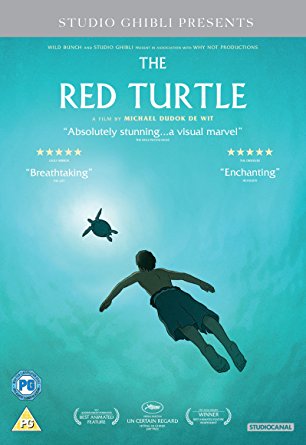 ‘The Red Turtle’ is an animated movie by Dutch film-maker Michael de Wit. Studio Ghibli appear in the producer credits, but their involvement seems to have been minimal. This hand-drawn animation shows a man stranded on a deserted tropical island. He tries to leave the island by constructing increasingly elaborate bamboo rafts, but each time he launches, a giant red turtle smashes the raft to bits, forcing the man to swim back to shore. More surprising events ensue. There is no dialogue.
To be honest, after the rave reviews in the quality press, I expected much of this, but was disappointed. The story isn’t much, and the animation, despite some nice touches and the detailed depiction of the rafts, does not look as interesting as a typical Studio Ghibli production. The screen is often occupied by large areas of uniform and uninteresting texture, and there are a lot of scenes, apparently representing dusk, in near monochrome.
As an amateur astronomer I was irritated by the generic random-dot depiction of the night-sky and moon. With a substantial budget they could have made this look more realistic. The night sky isn’t copyright.
Verdict – a miss.
My Life as a Courgette
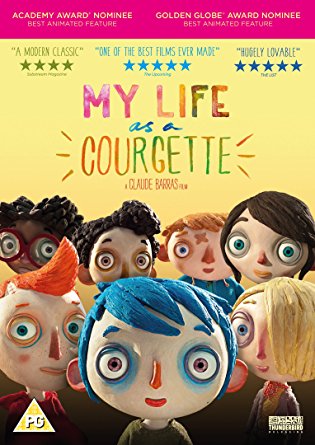 ‘Courgette’ is an European stop-motion animated film from director Claude Barras and writer Celine Sciamma. (64 mins) After losing his drunken mother in an unfortunate accident, nine year old Icare, nicknamed ‘Courgette’ is taken to a care home by a kindly policeman. The other kids have equally shocking backstories of abuse and neglect. Courgette has trouble fitting in at first, but a new girl, Camille, arrives whom he recognises as a kindred spirit.
The stylised puppets with their large heads and minimal expressions fit the story. Each child has a distinct character and it is hard not to sympathise with them. Their ill-informed conversations about sex are funny, and the disco scene is one of the highlights of the movie.
For once, the care system and carers get a positive report.
Parents: note that this is PG rated – Disney it’s not.
Highly recommended.
In This Corner of the World – movie
 In This Corner of the World is an animated film directed by Sunao Katabuchi and based on the works of Fumio Kouno. This is the story of young Suzu, who lives in the Hiroshima region from the 1930’s onwards. Suzu has artistic leanings, and the love of her life is a youth who becomes a naval officer, but she is married in an arranged marriage to a young man who works at the naval dockyard in another town. She finds herself in another household with a critical sister-in-law, and her life is increasingly one of making-do. And then American bombers start operating in the area. The shadow of the Hiroshima bombing hangs over the latter part of the movie.
An elegy to a lost past.
Highly recommended.
The Plain Girl’s Earrings
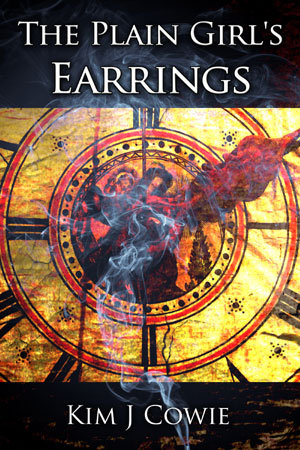
The ruthless Virnal Order rules over the Empire of Satine by fear, guile and an iron hand. Lethal poisons from a past cataclysm are leaking from the ground, causing sickness and death. Unseen insurgency seeks to overturn the established order.
Cadet Starsin only ever wanted a simple life, pursuing his own selfish interests, maintaining a mistress and adding to his meager army pay by trading in ancient artifacts. But when he witnesses the cold blooded murder of a much admired officer by Virnal enforcers, Starsin feels impelled against his instincts to protest. This marks him down as a trouble-maker and potential rebel.
Implicated in sedition, and with both the Virnals and a mysterious adventuress named Lannaira Hajan taking an unhealthy interest in him, Starsin’s mundane life is turned upside down. His own ambiguous past threatens an explosive revelation.
Take a journey across a troubled land with Starsin, as he battles the Virnals, uncovers shocking secrets and finds that he is not the man he thought he was.
Look Inside or buy it on:
Amazon
Winter Anime 2017
I have not watched much anime lately, other than going to see “Your Name”, so thought I might check out some of the new season.

The hero moves to a new school, and on the first day a girl collides with him and then accuses him of taking an upskirt photo. She smashes his phone before taking off. Later, he discovers that this girl, the hyper-energetic Fuuka, attends the same school. After some more misunderstandings, Fuuka sees something to like in him and they go on a sort-of-date. There is nothing very original here – boring boy meets dream girl has been done before – but it is quite pleasantly done.
Onihei:
In this period piece, a thief is captured and tortured by the Arson Theft Control section of the Edo police. The section is headed by Heizo, also known as Onihei. Heizo sends the thief out to look for a gangster called Tanbei who is commmitting a series of robberies and murders. The thief thinks that Tanbei, his former boss, is being impersonated by someone else. This series is adapted from a novel, and is done in the style of a 1960’s police procedural. The story is rather dark in theme, and the animation is also rather dark. It’s not bad.
Miss Kobayashi’s Dragon Maid:
Kobayashi gets drunk one evening and invites a dragon-girl to stay with her. She is considerably put out when the dragon turns up next day asking to stay. The dragon-maid tries to do the housework with amusingly destructive results. I’m not a great fan of maid anime and it did not do much for me.
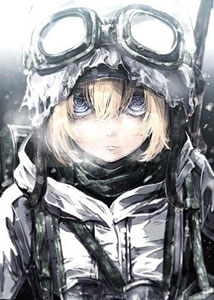
This is set in an alternative world, where an empire similar to Germany under the Kaiser is battling the surrounding nations, as if WWI never ended, and using magical forces. On the Empire side is Tanya, a 10-year old magical soldier who can fly and use magical weapons. Tanya has the personality of a middle-aged person and is ruthless and totally devoted to warfare, sending disobedient underlings to their deaths and finishing off enemy detachments single-handed. Whether you like this depends on how you respond to Tanya’s deliciously evil personality.
Drifters:
Shimazu Toyohisa, whilst involved at the Battle of Sekigahara on the losing side, manages to mortally wound Ii Naomasa, but is critically wounded in the process. As he walks from the field broken and bleeding, Toyohisa finds himself transported to a corridor of doors, where a bespectacled man at a desk waits for him. This man, Murasaki, sends Toyohisa into the nearest door where he wakes up in another world. There, Toyohisa meets other great warriors like him who have been transported as well, to be part of a group known as “Drifters.” These warriors turn out to be from different eras and (in later episodes) from different countries. They are in a magical world populated by elves and magicians.
The first episode is basically the set-up, but it looks as though it might be interesting. Odd-looking character designs.
Dagashi Kashi:
Kokonotsu and his father YÅ live in a countryside town where they run a small sweets store. He aspires to be a manga artist, an ambition that puts him at odds with his father who wants him to inherit the store which has been run by the family for eight generations. Also in the story are Hotaru Shidare, an eccentric rich girl and daughter of a sweets factory owner who wants to hire father YÅ. YÅ will not agree unless Kokonotsu agrees to take over the store. Also involved are twins who run a cafe: Saya Endo, a girl who has a crush on Kokokatsu and her brother TÅ Endo. It is quite amusing, and the girls are cute.
Showa Genroku Rakugo Shinju:
The Rakugo series continues. By far the best series this season.