Children Who Chase Lost Voices (2011 movie) by Makoto Shinkai, also known as Journey to Agartha.
Agartha is a world under the earth, a place of great beauty and also unimaginable dangers. It has a reputation as a place in which the dead can be brought to life. The young heroine, Asuna, sees a monster that has come up from below and is rescued by a boy, Shun, who has also come from Agartha. Asuna’s new schoolteacher, Mr Morisaki, turns out to know a lot about Agartha legends, and his beloved wife died some years ago. Asuna has also lost her father.
Asuna is dragged into Morisaki’s quest and enters Agartha, where she has a series of frightening adventures.
This movie is pretty good and has a somewhat darker tone than a typical Studio Ghibli movie. The animation is perhaps not as slick as a Studio Ghibli product and the resolution a shade muted.
‘A Letter to Momo’ is an animated movie from Production IG, directed by Hiroyuki Okiura. (120 mins).
Young Momo’s mother returns to her native island in the Japanese Inland Sea after the sudden death of Momo’s father. Momo is upset because she argued with her father just before his disappearance. She carries the beginning of a letter to her that her father started but left unfinished.
The story starts as family-centred but supernatural elements gradually intrude. Three greedy goblins have been assigned by Above to watch Momo and her mother. A fairly gentle comedy-drama develops.
I liked this movie a lot. The human character designs are attractive, Momo is an appealing character, and the backgrounds are very detailed.
This movie was released in 2011 but seems to have attracted little attention. The edition I bought is the UK Collector’s Edition, with BD+DVD in an attractive slip-cased box, with a booklet about the making of the movie.
Highly recommended.
‘The Red Turtle’ is an animated movie by Dutch film-maker Michael de Wit. Studio Ghibli appear in the producer credits, but their involvement seems to have been minimal. This hand-drawn animation shows a man stranded on a deserted tropical island. He tries to leave the island by constructing increasingly elaborate bamboo rafts, but each time he launches, a giant red turtle smashes the raft to bits, forcing the man to swim back to shore. More surprising events ensue. There is no dialogue.
To be honest, after the rave reviews in the quality press, I expected much of this, but was disappointed. The story isn’t much, and the animation, despite some nice touches and the detailed depiction of the rafts, does not look as interesting as a typical Studio Ghibli production. The screen is often occupied by large areas of uniform and uninteresting texture, and there are a lot of scenes, apparently representing dusk, in near monochrome.
As an amateur astronomer I was irritated by the generic random-dot depiction of the night-sky and moon. With a substantial budget they could have made this look more realistic. The night sky isn’t copyright.
Verdict – a miss.
In This Corner of the World is an animated film directed by Sunao Katabuchi and based on the works of Fumio Kouno. This is the story of young Suzu, who lives in the Hiroshima region from the 1930’s onwards. Suzu has artistic leanings, and the love of her life is a youth who becomes a naval officer, but she is married in an arranged marriage to a young man who works at the naval dockyard in another town. She finds herself in another household with a critical sister-in-law, and her life is increasingly one of making-do. And then American bombers start operating in the area. The shadow of the Hiroshima bombing hangs over the latter part of the movie.
An elegy to a lost past.
Highly recommended.
I have not watched much anime lately, other than going to see “Your Name”, so thought I might check out some of the new season.
FuukaFuuka:
The hero moves to a new school, and on the first day a girl collides with him and then accuses him of taking an upskirt photo. She smashes his phone before taking off. Later, he discovers that this girl, the hyper-energetic Fuuka, attends the same school. After some more misunderstandings, Fuuka sees something to like in him and they go on a sort-of-date. There is nothing very original here – boring boy meets dream girl has been done before – but it is quite pleasantly done.
Onihei:
In this period piece, a thief is captured and tortured by the Arson Theft Control section of the Edo police. The section is headed by Heizo, also known as Onihei. Heizo sends the thief out to look for a gangster called Tanbei who is commmitting a series of robberies and murders. The thief thinks that Tanbei, his former boss, is being impersonated by someone else. This series is adapted from a novel, and is done in the style of a 1960’s police procedural. The story is rather dark in theme, and the animation is also rather dark. It’s not bad.
Miss Kobayashi’s Dragon Maid:
Kobayashi gets drunk one evening and invites a dragon-girl to stay with her. She is considerably put out when the dragon turns up next day asking to stay. The dragon-maid tries to do the housework with amusingly destructive results. I’m not a great fan of maid anime and it did not do much for me.
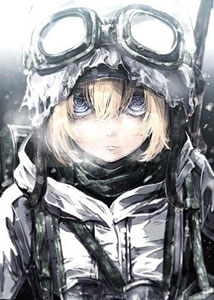
Youjo Senki/TanyaSaga of Tanya the Evil:
This is set in an alternative world, where an empire similar to Germany under the Kaiser is battling the surrounding nations, as if WWI never ended, and using magical forces. On the Empire side is Tanya, a 10-year old magical soldier who can fly and use magical weapons. Tanya has the personality of a middle-aged person and is ruthless and totally devoted to warfare, sending disobedient underlings to their deaths and finishing off enemy detachments single-handed. Whether you like this depends on how you respond to Tanya’s deliciously evil personality.
Drifters:
Shimazu Toyohisa, whilst involved at the Battle of Sekigahara on the losing side, manages to mortally wound Ii Naomasa, but is critically wounded in the process. As he walks from the field broken and bleeding, Toyohisa finds himself transported to a corridor of doors, where a bespectacled man at a desk waits for him. This man, Murasaki, sends Toyohisa into the nearest door where he wakes up in another world. There, Toyohisa meets other great warriors like him who have been transported as well, to be part of a group known as “Drifters.” These warriors turn out to be from different eras and (in later episodes) from different countries. They are in a magical world populated by elves and magicians.
The first episode is basically the set-up, but it looks as though it might be interesting. Odd-looking character designs.
Dagashi Kashi:
Kokonotsu and his father YÅ live in a countryside town where they run a small sweets store. He aspires to be a manga artist, an ambition that puts him at odds with his father who wants him to inherit the store which has been run by the family for eight generations. Also in the story are Hotaru Shidare, an eccentric rich girl and daughter of a sweets factory owner who wants to hire father YÅ. YÅ will not agree unless Kokonotsu agrees to take over the store. Also involved are twins who run a cafe: Saya Endo, a girl who has a crush on Kokokatsu and her brother TÅ Endo. It is quite amusing, and the girls are cute.
Showa Genroku Rakugo Shinju:
The Rakugo series continues. By far the best series this season.
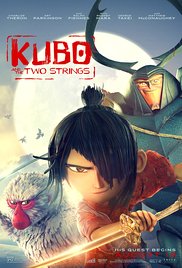
Movie, BD, 101 mins, 2.35:1, 2016, by LAIKA
I saw this got some very good reviews so I invested in a BD copy.
The story is set in a fantasy Japan. A woman is washed up on a beach by a storm. With her is a baby which appears to have lost one eye. Ten years or so later the two are not doing great. They live in a cave and the mother is mostly catatonic while the boy does story-telling at a local village. He uses some powerful magic from his three-string shamisen to turn sheets of paper into origami figures to act out his stories.
His mother warns him never to stay out after dark otherwise bad things will happen. Of course, on the day of the O-bon festival he does stay out and his aunts, scary black figures, fly out of the gloom and attack him. His mother uses the last of her magic to let him escape, and so Kubo embarks on a quest for a magical sword and armour, accompanied by a monkey and a beetle.
I loved this. The Japanese village setting is carefully researched. The animation is done in stop-motion, with CGI processing, and what you see on screen is often beautiful. The story moves through a large number of settings, with magic, and fight scenes, before reaching a conclusion. Recommended.
The animators, LAIKA, are the same people who did Coraline and other successful animations.
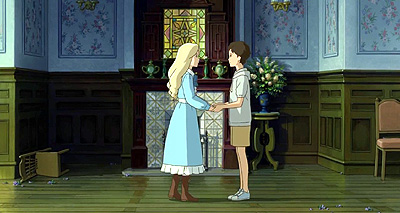
When Marnie Was There (Omoide no Mani) (2014)
An animated release from Studio Ghibli, adapted from the novel by Joan G Robinson and directed by Hiromasa Yonebayashi. The original book was set in England, but the movie is set in Japan.
Anna Sasaki has a difficult relationship with the aunt who is acting as her foster parent, and is sent to stay with other relatives at the seaside. Here Anna fails to bond with the local schoolchildren but meets the mysterious blonde Marnie who lives in a mansion across the tidal marsh. It seems that Anna is the only person who can see Marnie and the mansion is long deserted.
Regardless, the relationship between the two girls develops, but surprises are in store.
This is definitely one of Studio Ghibli’s better efforts, and is a good-looking film that repays multiple viewings. It is less action-packed than some, and in feel it probably most resembles the later adaptations of non-Japanese books, e.g. “Arrietty”. Anna is a more troubled child than any of the other Ghibli heroines, and the movie has an emotional impact. The plot contains some unexpected twists.
I suggest that you get the BD version if you have a player. Recommended.
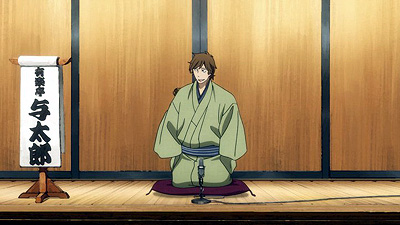
Shouwa Genroku Rakugo Shinjuu is a Noitamina adaptation of a josei drama manga. In the 60s a former petty thief nicknamed Yotaro gets out of prison and becomes the apprentice of a famed rakugo performer named Yakumo. Yotaro joins Yakumo’s household, which also includes Konatsu, the orphaned daughter of a former rakugo colleague of Yakumo, Hatsutaro. Rokogo is a traditional one-man storytelling art form in Japan in which the lone performer re-tells traditional comic stories with very limited props while performing multiple roles in the story.
After the first episode, the story is a flashback to of a younger Yakumo, nicknamed Kikohiro, and his friend/rival Sukeroku, nicknamed Hatsutaro. Initially the outgoing Hatsutaro is a more successful storyteller than the repressed Kikohiro.
Kono Subarashii Sekai ni Shukufuku o is essentially a parody of teens-in-an-RPG-world type stories. Teen gamer Kazuma rarely leaves the house unless he absolutely has to, but one day he does leave in order to buy a new game. On his way home Kazuma sees a girl classmate who is about to be run over and pushes her out of the way, dying himself instead. In fact the girl was in little danger from the tractor.
After his death, Kazuma arrives in a transitional world where a minor goddess Aqua tells him his options. One is to go to a RPG-type world, taking one thing with him. So he chooses her.
Following episodes have Kazama trying to start a quest in the RPG world, and collecting some female comrades, all equally dysfunctional. This show is very funny.
Mahou Shoujo Nante Mouiidesukara
An average schoolgirl is accosted by a ball with wings lurking among the rubbish bags, and the creature tells her that she is a magical girl. She gets transformed and discovers to her embarrassment that her costume is a two-piece swimsuit. The comedy revolves around the creature trying to combat her lack of enthusiasm and train her.
This is pretty funny, and if you don’t agree the pain only lasts for 4 minutes. It feels a little pervy to be watching a pubescent girl in a bikini, though.
Tabimachi Lateshow
Comix Wave Films is producing four episodes with the theme of “goodbyes and journeys,†entitled “Recipe,†“Transistor Smartphone,†“Summer Festival,†and “Cloverâ€, as part of the Ultra Super Anime Time programming block broadcast in Japan.
So says the Crunchyroll trailer.
I watched the first two, and found that while the animation is basic, the scripts are less bland than the usual fare.
In the first of two unrelated episodes, a trainee chef labours to match his mentor’s recipe for what appears to be spaghetti with tomato sauce. (Perhaps a satire on cooking anime shows)
In the second, an episode about a friendly schoolgirl trying to befriend a loner leaves one wondering which of them is the more dysfunctional.
It could be worth checking out this series to see what you make of it.
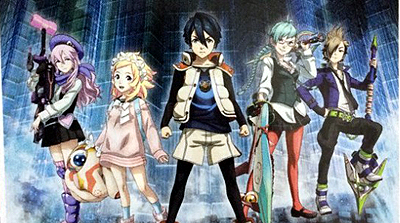
Bubuki-BurankiBubuki Buranki We start out in what appears to be an idyllic forested setting with ancient ruins covered by plant growth. Two six year old twins frolic through the forest and get into mischief, such as climbing up an ancient “Neo Rangaâ€-style mecha-golem giant. Seems that the golems are giant robots being curated by the twins’ mother. Things start to go wrong when the more assertive twin, the girl, climbs on a robot and activates it. Several robots activate and fall to the Earth far below, and the twins and father are sent there while the mother tries to sort things out. Fast forward to ten years later with the boy on a dystopic Earth where super-powered adults and teens battle each other using giant mechas and magic.
The show looks good, being done in 3DCG, but the story is full of rather familiar elements.
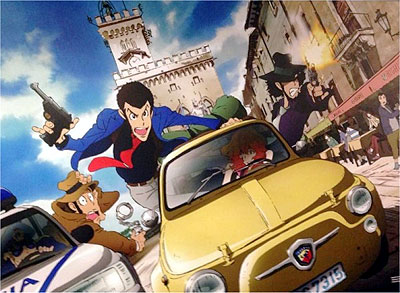
Lupin III (2015) is one of the more entertaining shows of the new season. This show is set in Italy, and was released in Italy this August. It looks much the same as the movies and the dialogue is the usual banter between the familiar Lupin characters.
Lupin is trying to lift the treasure of a small principality and goes through a marriage with an Italian princess, much to the disgust of Lupin’s long-term associate Fujiko.
The wife turns out to be a match for Lupin in a manner other than the intended, and some far-fetched hijinks ensue. Seems she is set to be a new significant character.
Looks like this will be fun.
Young Black Jack: An anime prequel to Osamu Tezuka’s classic manga series about a maverick doctor with a disfigured face. It starts with ‘Jack’ still at medical school but developing amazing surgical skills. In the first episode he re-attaches the arm of a young boy severed in a train accident. In the second he is kidnapped and blackmailed to perform a heart transplant. This is gripping stuff and worth a look.
Beautiful Bones – Sakurako’s Investigation: A teenage boy has an odd relationship with an older woman who is obsessed with collecting bones. Every time they go on a bone hunt, they come across human remains and Sakurako makes forensic deductions. The first episide was very watchable.
Owarimonogatari: Another story in Akiyuki Shimbou’s “Monogatari” series. This looks like one of the more duff sections, as both the new major characters are dislikable and it’s also very static and talky. The first episode on Crunchyroll was a double length, and the whole story is about school student Koyomi Araragi’s awkward past relationship with another student.
Utawarerumono – The False Faces Fantasy series. In the first episode the slacker hero, wandering in a wilderness, is attacked by a giant bug and saved by a young woman who takes him to a village where he is forced to work. Not great, but quite diverting.
Concrete Revolutio: Choujin Gensou, a “Watchmenâ€-influenced original superhero series, has turned into a dark and complicated “wheels within wheels†tale that is essentially an “anti-superhero†story. It is a wonderfully bleak, bitter, paranoid and smart parallel world story where superheroes and super monsters take the place of nuclear weapons.
Different episodes appear to take place in different eras from the 1930’s to the 1970’s. Essentially, a secret group of superheroes tries to protect the intrests of superheroes and recruit them. In society at large, superheroes are feared and distrusted, and public mention or discussion of them is banned.
Charlotte was the only new anime I followed through the whole run. The story takes part in an alternate reality where a small number of children manifest supernatural powers on reaching puberty. The protagonist, Yuu Otosaka, develops the power to temporarily possess others, and uses it to cheat at exams. He is exposed by Nao Tomori, a girl who can make herself invisible to a specific person. Nao forces him to transfer for his own protection to Hoshinoumi Academy, and join the student council, of which she is president. The purpose of the council is to contact and retrieve teenagers with powers before they are exposed and experimented on by organisations intent on exploiting their powers.
Yuu, initially dislikable, becomes a sympathetic character as he and the cute Nao contact various teenagers with weird powers. Then there is a head-banging plot twist halfway through the series …
Not a great anime, but an enjoyable watch.
Also checked out: Akagami no Shirayukihime (Red-haired Snow White): A shoujo romantic drama in which a girl is pursued by a prince she doesn’t like. Silly. Dropped after 1 episode. Rokka no Yuusha Six heroes are chosen to defeat a demon king. Dropped after three episodes. Ushio and Tora (2015) remake of old anime. Not bad, but I didn’t want to watch it all again. Monster Musume no Iru Nichijou A switch-off. Dire. Okusama ga SeitokaichÅ (My wife is student council president). The main character loses the school council president election to a girl who gives out free condoms and advocates free love. She then moves into his house. I think you can guess where this piece of soft porn is going. 🙁 Aoharu x Kikanjuu Another survival-game anime, but with a girl disguised as a boy. Dropped after one episode. Gate: Fantasy characters rampage into Tokyo through an inter-dimensional ‘gate’ but are soon shot down. Then the Japanese government launches an inter-dimensional invasion and counter -attack. Potentially interesting idea but the characters didn’t grab me. Dropped. Shimoneta to Iu Gainen ga Sonzai Shinai Taikutsu na Sekai: Very rude and funny comedy about a Japan where all reference to impropriety is banned. The hero enrolls in the leading elite school of morals, but is soon blackmailed into joining an association opposing public morals and ends up taking part in obscene acts of terrorism against the student council president, a beautiful girl whom he happens to have be in love with. The first episode was a hoot, and clearly directed against the current tightening up of comics and anime censorship in Japan, but I had a feeling the joke would turn stale long before the end of the series..
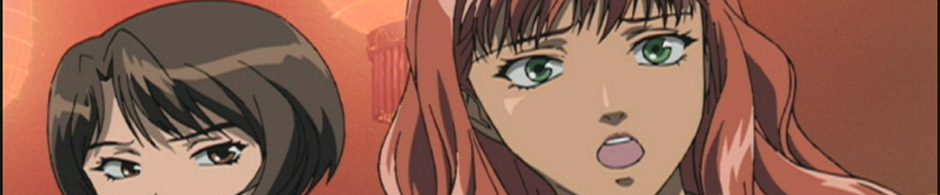
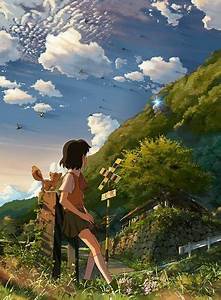 Children Who Chase Lost Voices (2011 movie) by Makoto Shinkai, also known as Journey to Agartha.
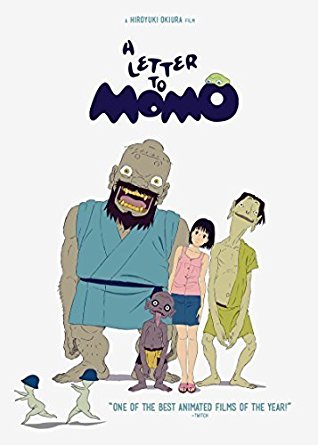 ‘A Letter to Momo’ is an animated movie from Production IG, directed by Hiroyuki Okiura. (120 mins).
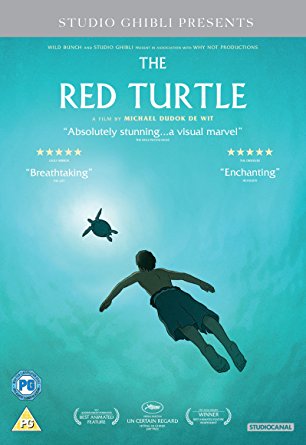 ‘The Red Turtle’ is an animated movie by Dutch film-maker Michael de Wit. Studio Ghibli appear in the producer credits, but their involvement seems to have been minimal. This hand-drawn animation shows a man stranded on a deserted tropical island. He tries to leave the island by constructing increasingly elaborate bamboo rafts, but each time he launches, a giant red turtle smashes the raft to bits, forcing the man to swim back to shore. More surprising events ensue. There is no dialogue.
 In This Corner of the World is an animated film directed by Sunao Katabuchi and based on the works of Fumio Kouno. This is the story of young Suzu, who lives in the Hiroshima region from the 1930’s onwards. Suzu has artistic leanings, and the love of her life is a youth who becomes a naval officer, but she is married in an arranged marriage to a young man who works at the naval dockyard in another town. She finds herself in another household with a critical sister-in-law, and her life is increasingly one of making-do. And then American bombers start operating in the area. The shadow of the Hiroshima bombing hangs over the latter part of the movie.
 Movie, BD, 101 mins, 2.35:1, 2016, by LAIKA