The Summer Anime season is starting, so here’s my impressions of the first items to be shown:
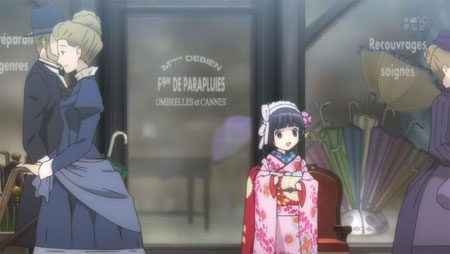 Ikoku Meiru no Croisee: In 1890’s Paris, a French trader brings back from Japan a small Japanese girl, with the notion that she can work as a maid at his grandson’s decorative ironwork shop, and attract customers. The grandson, initially, isn’t at all keen, and there are some cultural misunderstandings between the child, (fully dressed in traditional Japanese costume) and the French.
The plot of the first episode hinges on the characters speaking two different languages and being largely unable to understand each other, and for me the effect was ruined by having the whole thing dubbed in Japanese. [I should declare an interest in that I understand French and a little Japanese.] Perhaps things will improve in following episodes when the characters are all speaking the same language.
Sacred Seven: In this one, a loner schoolboy sees a supernatural monster destroy a passenger ship. There’s also a nice girl in his class who takes an interest in him. So far, we’re on familiar ground. However, when the anti-monster squad turn up, and turn out to be headed by a teenage girl addressed as “Milady” and driven around in a limousine, and their footsoldiers are gun-toting young women in sexy maid outfits, one starts to think that this anime may not be taking itself too seriously… Anyway, Milady tries to recruit our hero, much to his annoyance, and is rebuffed. The monster goes on the rampage again, and our hero does his transforming thing, and wins this round of the battle. Sacred 7 isn’t great, but looks like it could be good fun.
Rou Kyuu Bu! A high school boy is pressured by his older sister, a teacher, to coach an elementary school girls’ basketball team. Sis’s motives are partly to alleviate the lad’s basketball deprivation, his own team having being disbanded because of a scandal involving an under-age girl. Determined to create a good impression the five girls greet their coach dressed in maid outfits. Not much coaching gets done.
if you like a loli-fest, with semi-nudity, panties, and sex jokes, this could be for you. Personally, I prefer to keep this sort of thing at arm’s length. Nothing suggests that Rou Kyuu Bu will rise above this undistinguished start.
Double-J: An anime short with a running time of about 4 minutes. It seems to be a school slice-of life comedy. In the first episode, two girls visit a school club dedicated to the preservation of traditional arts. However the members seem to be doing pointless stuff like carving on the ends of toothpicks. It was quite amusing, and since it’s so short, seems worth the effort of following for a while.
Blade: Another anime with an American Marvel Comics link. The eponymous hero is a tough dude who despatches vampires with his silver-edged sword. This looks like the most satisfactory of the Marvel Comics co-productions, with plenty of action, and a vampire deletion-count running into double figures in the first episode.
Kami-sama no memo-chou (God’s Notepad):The characters include an ineffectual high school student, Narumi, and a teenage shut-in (hikkomori), known as Alice, and Alice’s gang of slackers, who with her form a detective agency. Alice, who spends all her time dressed in her pyjamas, in her apartment full of video screens, is definitely a loli. Narumi witnesses a violent incident, and thus meets Alice’s gang, who are investigating a mystery involving paid-for dating. The series has a relatively adult feel to it, and there’s some “fan-service”. Possible influences come to mind, perhaps too quickly (Victorique in “Gosick”, and “Durarara” to name two) and there’s the ubiquitous nice high-school girl taking an interest in our hero. Despite that, this is a well-made and gripping opener that holds the viewer’s attention over the opening double-episode, and is the best item in the new season I’ve seen so far.
Yuri Yuri: Three schoolgirls attend their first day at middle school, and soon form the Amusement Club. The red-haired girl in particular is a klutz, who wakes late and forget’s it’s her first day at school. Gag-based comedy with yuri elements. Don’t expect much of this juvenile stuff. Sasameki Koto it’s not.
Kamisama Dolls (God Dolls): College student Kyohei has escaped his oppressive village to study in Tokyo. Unfortunately it follows him there in the form of his younger sister Utao and the kukuri or god-doll. Their conversation is interrupted by his insane elder brother who has escaped from a cell in the village, with his kukuri, and has been leaving a trail of slaughter. On the plus side, a nice girl from the village lives nearby, and she and her father offer Kyohei and Utao somewhere to stay after Kyohei’s apartment is wrecked.
This is a straight supernatural drama, but I wasn’t altogether convinced, and there is a nagging feeling that I’ve seen something like the kukuri before.
Morita-san wa Muguchi (Taciturn Morita): TV anime with episodes a few minutes long, about a girl who thinks so much about what she has to say that she never says anything. Mildly amusing, and an idea I can relate to, and since it’s so short, it mightn’t hurt to watch some more episodes to see if it’s any good.
Blood-C: An original vampire story, from Production IG and CLAMP. It retains the name of the heroine from the original “Blood”, but here she is a cute-ified schoolgirl, tall and elongated in a distinct CLAMP style, and so clumsy she can’t run in a shrine costume without falling over, and so goody-goody she can’t pass a piece of litter without clearing it up. Despite that, she manages to deal with an attack by a malevolent stone statue efficiently enough, though getting blood-spattered and nearly killed in the process. Her dad walks down to check on the result, and Saya’s dialog can be paraphrased as “Hey dad, I killed the old one. No I’m not hurt a bit!” I wasn’t impressed, and I don’t think I’ll be following this one.
Poka Poka Mori no Rascal (Rascal of Snag Forest): Another short animation. Rascal Raccoon was a World Masterpiece Theater anime some decades ago. It’s not entirely clear whether this is an updated remake or a parody. Anyway, this anthromorphic character wakes up, and we have a raccoon version of the anime staple: gets up late, dresses in hurry, bolts breakfast, forgets bento box, rushes to meet waiting childhood girlfriend. Ho Ho. Small kids might enjoy. You’ll probably agree that one episode is enough.
Kaitou Tenshi Twin Angel – Kyunkyun Tokimeki Paradise: (Twin Angel Twinkle Paradise) a magical-girl show in which two schoolgirls transform in order to fight the bad guys. There identity is secret, and there’s a masked youth who helps them out. There’s a rather old-fashioned feel about this show. It’s played for laughs, and it’s as dumb as it could be without being a parody. Kids might enjoy it, but I shan’t be lingering here. Looks like evidence that Mahou Shoujo Madoka Magica inflicted fatal damage on the magical-girl anime genre.
Nyanpire: A kitten is dying in the street, when a vampire saves its life by feeding it vampire blood. Revived, and with a human mistress, kitty keeps demanding blood, and guzzles red products from the larder, while turning its nose up at raw fish. Ho ho, or rather, yawn. On the other hand, the live-action ED, with various young persons in costume doing a song and dance number and waving blood bags etc. is a riot. I recommend that you get this video and fast-forward to the ED.
Natsume Yujincho: Sequel of show in which young man releases youkai who have been bound to his grandmother’s magic book. It’s not bad (same quality as before). A direct continuation – Crunchyroll tag the first ep as #27.
Usagi Drop: Thirty-year-old bachelor Daikichi attends his grandfather’s funeral. Here he learns that his 79-year old grandfather had a mistress and an illegitimate child. None of the other relatives want to have anything to do with the silent little girl, Rin, so Daikichi asks her if she wants to come home with him.
The artwork looks good, and the storytelling skewers its marks without being overstated. The relatives are driven by selfishness and social convention, and the other child at the funeral, Reina, legitimate and wanted, is an annoying and attention-seeking brat. Daikichi’s caring feelings towards his child-aunt are well shown. While Rin is quite cute, there’s no hint of impropriety here. This looks well worth following, and looks to be one of the best of the new season.
No. 6: In a hi-tech city of the future, Shion, a bright and privileged 12 year old boy, spends his birthday at school and with a female friend. During a rainy night, he shelters a runaway boy, Nezumi, who is wounded and clearly comes from a much more brutal environment. Nezumi, when questioned, alludes to unpleasant facts about the city that Shion shouldn’t even want to know. In the morning, the police ring Shion’s mother’s door bell…
An intriguing opening, in a show that doesn’t stretch credulity. It will be worth following it to see how it develops.
Mawaru Penguin Drum (Penguin Drum Circle): A terminally ill girl, Himari Takakura, collapses while her brothers are taking her out for a special treat and dies in hospital. Everyone is shocked when she abruptly revives and seems fit to go. It seems that the penguin hat which one of the brothers bought her had something to do with it. Three blue penguins that nobody else can see arrive in a packing case and start helping the family. However it seems the magic world wants something in exchange.
A really strange show! It seems worth following to see how it shapes up.
Mayo Chiki!: Kinjirou discovers that the cold but beautiful boy who is employed as butler to his wealthy classmate is actually a girl. The butler attacks Kinjirou and the two enforce his silence with physical threats. This is nothing new to Kinjirou since his mother and sister are martial artists, and his sister regularly uses him as a punchbag. So, another ecchi gender-bending comedy. However, with a butler, a filthy rich classmate, absent parents, and cross-dressing, it’s so far removed from real life that one is left contemplating the idea that patterned panties are supposed to be funny.
Uta no Prince-sama Love 1000%: Haruka succeeds in getting into an elite high school for the performing arts. Her goal is to become a songwriter. On her first day she encounters several male bishounen. Seems she eventually has to choose one as a performing partner. Adapted from a game for girls.
This is clearly aimed at young celebrity-obsessed girls, and while it may succeed admirably with its target audience it did absolutely nothing for me. Also, the heroine has strange eyes that make her look like one of the undead.
Itsuma Tenma no Kuro Usagi (Black Demon Rabbit Someday): Another case where the fad for using the Japanese title, even though few know what it means, could look a little stupid. Nobody could forget “Black Demon Rabbit” (or, less literally, ‘A Dark Rabbit has Seven Lives’) in a hurry, even though it seems to have nothing to do with the story so far. Ordinary student Taito keeps having dreams about a girl who bites him in a vampirish way, making him her lover and slave for ever. This girl isn’t to be confused with nice girl Haruka, who is interested in Taito, and apparently isn’t the red-head who hangs around arrogant student council president Gekko Kurenai either. Taito is run over by a truck, and after putting himself back together (which makes him realise he’s not normal), he remembers what that girl did when they was six (rather precocious, when you think about it), and goes to meet her. Apart from Haruka, it seems that all the major characters have magical powers. There’s quite a lot of fan-service.
Overall, I wasn’t particularly impressed.
R-15: Takuto is enrolled in an elite high school full of brilliant and unconventional students. Takuto’s particular talent is for writing porn fiction, which he justifies by pointing out that sexuality is a central part of human nature. Various misunderstandings ensue in this ecchi comedy. With its fan-service, suggestive situations, and rude words, this show will rapidly put right anybody who still thinks that animation is just for little kids. It remains to be seen whether this show is just a succession of naughty incidents, or if it has anything serious to say.
Baka to Test to Shoukanjuu 2 (Baka and test: Summon the Beasts 2): I was quite amused by what I managed to see of the first series. In the opener of the second series, the principal character arranges a trip to the beach, but the boys end up being harassed by females who with equal violence resent being fancied and resent being ignored. Contains mild fan-service. Somehow it all seemed a bit pointless.
The IDOLM@STER: This is a series about a promotion agency, 765 Productions, training a dozen young women to become singing idols. It shows snippets of their daily activities: messing around at the office, making a hash of interviews, singing lessons, handing out flyers, and so on. Much of the dialog consists of text questions (originally in Japanese) posed by an unseen and unheard interviewer. Each character gets a big screen label (in Japanese) when she first appears. This show is quite funny, and with its adult characters and semi-documentary style is refreshingly different. I’ll be checking the next episode.
 I have added volume 1 of the “Eccentrics” manga to the other scanlations (of Himetarou, Hyouge Mono ch #4,#5, & Atsushi Kamijo’s “SEX” ch.#1.)