Mar
22
What was that anime, again….?
Filed Under anime | Leave a Comment
Asatte no Houkou (“A Direction of the Day After Tomorrow”)
Karada Iokawa is a young girl who transforms into a young woman. Shōko Nogami, a young woman who has just returned from studying abroad, happens to be the former girlfriend of Karada’s older brother. Shōko transforms into a young girl.
Akahori gedou hour rabuge: package name of pair of 12min-episode shows: Love Pheromone, about a pair of heroines who fight for justice but always cause more chaos than good, and Gedou Otome-Tai, about the five Hokke sisters, who are bent on becoming the world’s greatest Evil.
Otogi Zoshi (spotted in HMV shop, UK) – anime series set in Heian era Japan (1st 13 episodes, search for magical Magatama stones) and the present day (next 13 episodes).
Tenjho Tenge – martial arts/school anime with historic/supernatural overtones (not seen).
Comic Party – anime series inspired by, and satirizing the world of the Comiket dōjinshi or self-penned comic art conventions.
Cosprayers (Cosmopolitan prayers) a fantasy anime closely related to the anime Smash Hit, in that Smash Hit’s lead character Mizuki Ikuta, a diminutive girl, teased for her size, is the producer of Houchiku Corporation’s anime CosPrayers. “Love Love” is the third anime in the trilogy.
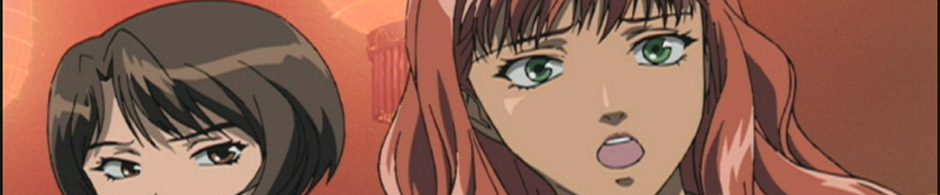
Gankutsuou – is an anime series loosely based on Alexandre Dumas’ “Count of Monte Cristo”. The anime is notable for its unusual character designs and the rendering of clothing, etc.
Gedo Senki – “Ged’s World” or, Tales from Earthsea, the controversial anime movie adaptation of Ursula K. Le Guin ’s “Wizard of Earthsea” novels. The movie was directed by Goro Miyazaki, son of the famous Hayao Miyazaki.
Hoshi no Koe = Voices of a Distant Star is a OVA by rising directorial star Makoto Shinkai, about two teenage lovers who communicate by text mail as they travel further and further apart.
Justy (Cosmo Police Justy) is an anime , made in 1985, in which the lead character is a police officer who hunts down criminal espers. He too is an esper, but wears a headband to limit his powers.
Mar
15
Otogi Jushi Akazukin
Filed Under Reviews, anime | Leave a Comment
Akazukin
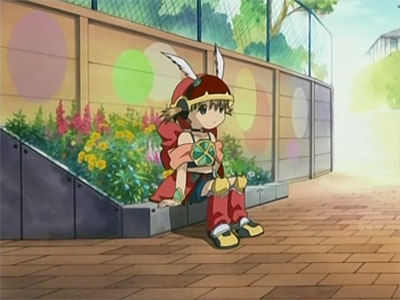
a.k.a. “Fairy Musketeers“. A lesser-known anime in which a young boy, Souta, has disturbing dreams in which he is rescued from a monster by a small girl in a red hat. His mother has told him bed-time tales of twin worlds, one being ruled by science, the other by magic. All too soon the dream starts turning into reality, as Souta finds himself pursued in his own world as the key to a magical power struggle. A monster attacks him and he is rescued by Akazukin and her wolf-companion, Val.
Souta’s fiercely possessive would-be girlfriend, Ringo, is less than pleased by Akazukin’s arrival, and still less when another magical girl, Shirayuki-hime,appears.
Shirayuki-hime
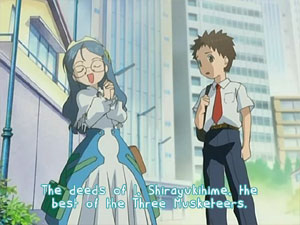
The character names are ripped off from various European fairy tales, and in general bear little connection to the original characters. Akazukin, (= Red Riding Hood) is a warrior girl accompanied by a blue-furred wolf. Shirayuki-hime, (= Snow-White) here is one of the three fairy Musketeers, a skilled magic user, much more intellectual than Akazukin, if a bit full of herself.
On the side of evil are Cendrillon (= Cinderella) a young sorceress with long dark hair and a husky voice, and a fondness for mirrors, Randagio, (= Puss in Boots), a bad cat, and Hansel, a sinister young wizard.
It’s clearly intended for younger viewers, being both cute and wholesome, but I enjoyed the characterisations of the grumpy wolf, the rather ineffectual bad cat, and the delicious Shirayuki-hime. Ringo (curiously named, it means “apple”) is that anime stereotype, the possessive would-be girlfriend, who keeps calling round to make sure Souta gets up in time for school, and to bring him snacks. Souta himself is rather a nonentity, but the vividness of the other characters make up for it.
If you enjoy light anime in which small girls beat up monsters, you should like this one. And those little girls are really too cute.
This anime exists in two versions, an OVA from 2005, and a TV reworking (2006-2007). Character designs are identical.
Mar
11
Horror Panegyric
Filed Under Books, Reviews | Leave a Comment
Yes, I had to look it up too… Panegyric, a eulogy, panegyrise, to praise highly.
Horror Panegyric by Keith Seward, published by Savoy Books. 125pp.
This short volume is an introduction to the three “Lord Horror” novels Lord Horror (1989), Motherfuckers, the Auschwitz of Oz (1996) and Baptised in the Blood of Millions (2000), also published by Savoy. An essay by Seward introduces the books, and is followed by lengthy excerpts from “Lord Horror” and “Motherfuckers”
Of the three, Lord Horror is mainly known for its un-availability, the result of a vigorous campaign of persecution by the Manchester police (the few extant copies are worth several hundred pounds each), while Motherfuckers was available via Amazon for a time. As you may surmise from the titles, they are not everybody’s cup of tea. The author, David Britton, chose to savage anti-Semitism by means of a brutal and gory satire that was too much like its object of attack for some to see the difference. Mimicking the homophobic rants of the then Manchester chief of police was not a prudent move either. Britton was sent to Strangeways jail for four months.
In the books “Lord Horror” is a fantastic character inspired by William Joyce, Lord Haw-Haw, of wartime infamy. The principals of the second book are Meng and Ecker, twins subjected to “scientific” experiments by Josef Mengele. They’re not nice – Ecker is rational but violent and Meng is a mutant with a huge cock and tits. There’s also a talking Volkswagen car called Herbie Schopenhauer. Auschwitz meets Oz.
Seward hails Motherfuckers as a masterpiece, and argues his case well. The reader can make up his (or her) own mind on reading the excerpts that follow at the end of “Horror Panegyric”. I used to find the three novels just too nasty to read, but after reading the panegyric and the excerpts I am inclined more to think that Seward has a point. He suggests that, just as it was said that it was impossible to write poetry after Auschwitz, a response to Auschwitz is to write in a deliberately barbaric way. The provocativeness of the books is perhaps a measure of their power and importance. Despite their extreme content, the books clearly have not provoked any rioting in the streets (only among police, judges and censors).
In any case, if you are interested in strong, cutting-edge writing, or radical literature, you owe it to yourself to obtain first the Panegyric and then Motherfuckers, and check it out for yourself.
Keith Seward lives in New York.