
Kaiba and creature Kaiba and creature

At last something really different in the new season! In an anime with a style somewhat reminiscent of the late Osamu Tezuka, a young man wakes in a totally strange-looking world. He has a large circular hole through his chest, and is wearing a medallion, and he can’t remember anything. In this world, memories can be separated from human bodies, and stored in pyramidal memory chips. They can also be traded and stolen. After some bewildering adventures in which he is variously helped and attacked, the main character, Kaiba, escapes in an aircraft.

This looks so different from the usual anime style that it’s fascinating to watch. I’ll follow this for a while to see how it turns out.
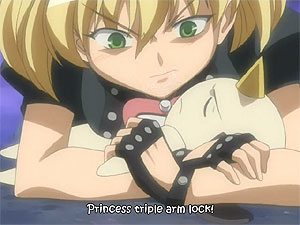

Punie wrestling with mascot Punie wrestling with mascot

This parody of magical-girl anime is more like magical-princess anime on crack, as sweet-looking Magical Princess Punie from the Magic Kingdom joins a Japanese school for a year on Earth. She has to do this to prove herself worthy of becoming Queen. Punie, in a flashback to how she acquired her mascot, looks more like a brutal and evil witch.

A schoolgirl gang, a frightening collection of burly and well-armed freaks, take an instant dislike to Punie, but when they try to sort her out, she invokes her magic, with the call of “Magical Tokarev, kill them all”, and unleashes a swarm of fighting vegetables. In a later sequence, Punie, with her magic temporarily blocked, demonstrates wrestling skills which are equally dangerous.

It’s almost a shame to tell you all this, as if you watched it as I did with only the vaguest idea what to expect, you might almost fall out of your chair in surprise.

So, is it worth watching? Certainly the first pair of mini-episodes are a lot of fun, and I’ll probably follow it a bit longer to see how it develops.

Slaughter at Sea by Mark Felton

Another book in my reading from the war section of the local library. This book is sub-titled “The Story of Japan’s Naval War Crimes.” The Japanese Imperial Navy (IJN) had poor relations with the Imperial Army. Consequently, the Navy gave all its recruits basic military training and had its own ship-borne soldiers who were frequently deployed onshore. The Navy was often given the task of administering captured islands and territories. As this book explains, this gave the IJN the opportunity to commit many land-based atrocities.

Clearly, the rape of Nanking (mentioned in reviews below) was not an isolated lapse, but symptomatic of a sinister general attitude towards anyone who fell under their power. In the territories over-run by the Japanese during World War 2, it was the norm for both military personnel and civilians, both white and non-white, to be ill-treated, robbed, and frequently murdered. This book details many incidents in which groups of captives were ill-treated and then murdered.

Most chilling is the revelation that it was official IJN policy, expressed in orders, that the crews of ships sunk by the IJN should be killed. In many cases, lifeboats were machine-gunned or rammed after the captain had been taken aboard the attacking vessel. American and British prisoners of war got no better treatment. If not murdered immediately, they would suffer ill-treatment while being interrogated and then transferred to “hell ships” taking them to slave labour elsewhere in the Japanese empire. Many were murdered on the Pacific islands after being held captive for some time. Others perished in several incidents where un-marked prison ships were torpedoed by Allied forces.

Allied naval sailors and airmen were often murdered in revenge for reverses, or even attacks, suffered by Japanese forces.

For the most part, the enlisted men and junior officers appeared to enjoy having the power to maltreat and kill prisoners, and had no problem at all in following orders to kill prisoners. In a very rare case, one Commander Junsuke Mii protested vigorously to several senior officers, including his Vice Admiral, about orders to “dispose” of a group of prisoners from a sunken ship. Mii sent ashore double the number he was ordered to, saving some thirty people. The rest of the captives were murdered and dumped at sea, the actual killing being done by junior officers and enlisted men using swords. Nothing happened to Mii, who was later promoted to Captain.

And why did the Japanese behave like this? Hard to say, but almost to a man they held the lives of non-Japanese to be of no account. And Japanese politicians can still be heard dismissing these war crimes today.

I found this book quite an eye-opener. It comes complete with notes, references, and brief accounts of war crime trials. Japan-ophiles will find this book uncomfortable reading, but it is part of a war record that, in common with the Jewish Holocaust, should not be brushed out of history.

Itazura Scene from Itazura no Kiss

Itazura na Kiss – traditional sort of school romance comedy where a girl from class “F”, the least able, has been for two years nursing a crush on Irie, a handsome boy from class “A”, and finally attempts to confess her love, only to find that he’s arrogant and hates stupid girls. Her father’s new house falls down, leaving them homeless. They are offered a place to stay by her father’s old buddy Irie who is none other than the father of Genius Boy Irie. She moves in, and finds that the boy isn’t at all friendly and even his rude kid brother is much smarter than her. Perhaps a bit early to say, but this looks like it could be a lot of fun.

Macross Frontier – same old tosh, but at least it’s superbly produced tosh.

Allison and Lillia – The politics look interesting, but it lost me when two of the main characters prang a motorcycle and sidecar combo, wrecking it, and then get up and run off to the next scene, and then “borrow” a light aircraft which just happens to be left in a hangar, unattended, fuelled up and with the keys in it.

xxxHOLiC Kei – a straight continuation of the previous and now licensed season of CLAMP’s comedy supernatural show. Lead character has a battle of obligations with his friend, and involving a vengeful spider. Looks good, worth watching.

Just had to restore the current theme which had become damaged. I also deleted a pair of files I didn’t recognise. I suspect this was a hacking attack. Wish somebody would introduce this guy to the gangs of organised criminals who keep trying to flood the site with comment spam and see how much they enjoy each other’s company…

Some recent reading:

“The Rape of Europa” by Lynn H Nicholas

You are probably aware that during the Second World War the Nazis stole a few paintings. This lengthy but very readable book details the full extent of the Nazi art looting. They started by seizing and suppressing or selling off what they considered “degenerate” (i.e. modern) art. Then when war was declared and they started to invade other countries, they had organisations set up to seize interesting art for the Fuhrer’s personal collection, for the new German state collection, and for the collection of Hermann Goering. Sellers were often forced to sell at unfavourable prices, and the property of Jews was often simply stolen. The quantities involved were astonishing, running into museums full, trainloads, salt mines full, over a million art items in all.
Meanwhile, national collections were being packed up all over the UK and Europe and shifted to safer accommodation.

When the Nazis were being defeated, the Allies put the process into reverse, setting up their own art protection and recovery teams, who followed closely behind the armies, trying to secure and protect what they could.

Many well-known works had an eventful and hazardous time during WW2, and an unquantified number of art items disappeared forever amongst the ruins. A trickle is still appearing today, as the descendants of those who took works into “safekeeping” go public.

A fascinating and eye-opening book, well worth reading.

“Tokyo” by Mo Hayder.

The Good German of Nanking – the dairies of John Rabe, edited by Erwin Wickert

Two books concerned with the notorious “Rape of Nanking” by the Japanese forces in 1937-38.

The first is a fictional thriller, in which the socially dysfunctional heroine, Grey, has been obsessed since childhood with the tale that a movie film record exists of some of the Nanking atrocities. She travels to Tokyo to interview an aged Chinese survivor of the massacre. She becomes convinced that this man has the film. While trying to persuade him to show her the film, she also gets involves with a nasty Yakuza gangster. The Nanking atrocities as depicted in the novel are also very nasty.

Over to the non-fictional diaries of John Rabe, who was a German businessman who worked in Nanking, running the Siemens office there. When the Japanese invaded, he felt obliged to stay on to protect his firm’s interests, and protect the Siemens Chinese staff and their dependants as best he could. He was also involved, with other foreigners, in setting up a “Safety Zone which they hoped would protect the Chinese civilians from the Japanese soldiers, not to mention the disorderly retreating Chinese troops. He also kept a diary.

One should recollect that at the time Germany and Japan were allies, so there is every reason to accept Rabe’s account as accurate. The Japanese troops killed all Chinese soldiers they could find, and also Chinese men whom they suspected of being soldiers, and broke into buildings looking for women to rape, killing any Chinese who resisted. They looted and destroyed throughout the city, and killed all livestock in the surrounding countryside, and embarked on a systematic looting and arson that eventually left much of the city in ashes. The Chinese were killed for resisting the ravages of the disorderly Japanese troops, or for no reason at all. In total, the number who died is thought to run to around a quarter of a million, though at the time nobody was counting the dead. Rabe’s efforts, though continually frustrated by Japanese indifference, are thought to have saved a similar number.